
March 2026 NewsletterISSN: 1933-8651
In this issue we present the following articles, news, announcements, and reviews:
|
Articles
News and Announcements
New Books
Book Review
|
The History of Black Studies
By Abdul Alkalimat
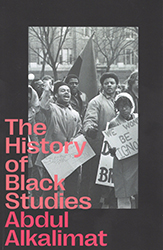
A surge of African American enrollment and student activism brought Black Studies to many US campuses in the 1960s. Sixty years later, Black Studies programmes are taught at more than 1,300 universities worldwide. This book is the first history of how that happened.
Black Studies founder and movement veteran Abdul Alkalimat offers a comprehensive history of the discipline that will become a key reference for generations to come. Structured in three broadly chronological sections -- Black Studies as intellectual history; as social movement; and as academic profession -- the book demonstrates how Black people themselves established the field long before its institutionalisation in university programmes.
At its heart, Black Studies is profoundly political. Black Power, the New Communist Movement, the Black women's and students' movements -- each step in the journey for Black liberation influenced and was influenced by this revolutionary discipline.
Abdul Alkalimat is a founder of the field of Black Studies and Professor Emeritus at the University of Illinois at Urbana Champaign. A lifelong scholar-activist with a PhD from the University of Chicago, he has lectured, taught and directed academic programs across the US, the Caribbean, Africa, Europe and China. His activism extends from having been chair of the Chicago chapter of the Student Non-Violent Coordinating Committee (SNCC) in the 1960s, to a co-founder of the Black Radical Congress in 1998.
This article provides an excerpt from this study, presenting the introduction chapter's roadmap to this remarkable history. You can obtain this volume from Pluto Press, other suppliers, and your local library.
[Read or download this full article here in Adobe .pdf format >>>].
[Return to table of contents]
Materiality of Freedom: Archaeologies of Postemancipation Life
Edited by Jodi A. Barnes
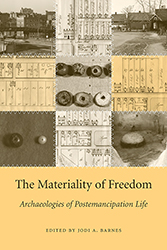
An excellent resource for fifteen years: Dr. Jodi Barnes convened an exceptional conference of researchers focused on postemancipation lives and then shaped their studies into a great collection of analyses.
From the publisher -- "The Materiality of Freedom uses the lens of archaeology to provide original perspectives on the painful Reconstruction and Jim Crow eras by studying the material culture inherent in the struggles for racial equality in America and the Caribbean. Editor Jodi A. Barnes and a cast of notable scholars focus their essays on racial and social strife experienced by African Americans seeking to exercise their newly won civil rights following the Civil War. By studying material objects in a variety of contexts, archaeologists enrich historical narratives and offer grounded insights on the racial and social strife experienced by people of African descent. Building on the body of literature on African American archaeology, the twenty-two contributors to this volume use historical records, maps, and artifacts to examine the material-culture dimensions of churches, cemeteries, plantations, communities, neighborhoods, and towns."
"The contributors to this collection assert that exploring the disheartening past of African Americans is essential to understanding contemporary issues of race and power as they delve into the archaeology of places such as the Harriet Tubman Home, the Phyllis Wheatley Home for Girls, Boston Saloon, and Alexandria, Virginia's Contrabands and Freedmen's Cemetery. Urban archaeology methods are also applied to prominent areas of Auburn, New York, Chicago, and the Old Salem Historical District in Winston-Salem. The Materiality of Freedom bridges past and present with community-based research and a combination of archaeological method and theory to highlight contemporary issues of class, gender, race, and social inequality. As these essays open new vistas on the social construction of race and racism, they also demonstrate a more hopeful view on the building of black communities and in the United States and the Caribbean."
"Barnes has done an excellent job of bringing together a collection of essays that deal with the various aspects of post-bellum African American life. This volume covers a broad geographic range, perhaps the most geographically comprehensive collection of African American studies that I know, which will widen our understanding of African American archaeology. This collection of essays neatly intersects contemporary and previously unpublished research with current events and contains a who's who of notable scholars in African American archaeology. The Materiality of Freedom is an important work that is well researched, timely, and well written." -- Joe Joseph, New South Associates and Past President of the Society for Historical Archaeology.
Contents: "Foreword" by Charles R. Cobb // "Introduction: The Materiality of Freedom -- Archaeologies of Postemancipation Life," by Jodi A. Barnes // "Black History as Property: A Critique of the Making of a Post-Civil Rights Landscape," by Christopher N. Matthews and Eric L. Larsen // "White Privilege and Silencing within the Heritage Landscape: Race and the Practice of Cultural Resource Management," by Jennifer J. Babiarz // "Living Not So Quietly, Not So on the Edge of Things: A Twentieth-Century Bahamian Household, by Laurie A. Wilkie and Paul Farnsworth // "Reaching For Freedom, Seizing Responsibility: Archaeology at the Phyllis Wheatley Home for Girls, Chicago," by Anna S. Agbe-Davies // "Victorian Ideals and Evolving Realities: Late-Nineteenth- and Early-Twentieth Century Black Dallas and An Engendered African America, by Megan Ann Teague and James M. Davidson // "'A Place Of Recreation Of Our Own': Archaeology of the Boston Saloon, by Kelly J. Dixon // "Archaeology of Jim Crow-Era African American Life on Louisiana's Sugar Plantations, by David T. Palmer // "From Slave to Citizen on James Island: The Archaeology of Freedom at Fort Johnson, by Carl Steen // "Examining Structural Racism in the Jim Crow Era of Illinois," by Christopher C. Fennell // "What Means Gottesacker? Leading and Misleading Translations of Salem Records," by Leland Ferguson // "Bakongo Cosmograms, Christian Crosses, or None of the Above: An Archaeology of African Americans Spiritual Adaptations into The 1920s," by Kenneth L. Brown // "Infrastructure and African American Achievement in Annapolis, Maryland, during The Twentieth Century," by Matthew M. Palus // "Race, Displacement, and Twentieth-Century University Landscapes: An Archaeology of Urban Renewal and Urban Universities," by Paul R. Mullins and Lewis C. Jones // "Excavating Inspiration: Archaeology at the Harriet Tubman Home, Auburn, New York," by Douglas Armstrong // "Epilogue: Reflections on Archaeologies of Postemancipation from a Student of Slavery," by Theresa A. Singleton.
This volume is available from the University of South Carolina Press, other suppliers, and a library near you. A useful bibliography or resources derived from this collection of studies is also available online.
[Return to table of contents]
2026 Archaeological Field Schools Addressing African Diaspora Subjects
The following field school list includes announcements posted by the field school directors and others listed on various directories. The field school announcements that follow are presented below in alphabetic order by location.
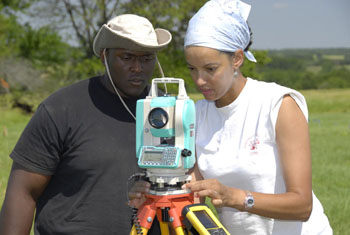
Caribbean: Providence Island Heritage Archaeology. Historical Archaeology, Ethnography & Community Oriented Outreach. Instructor: Dr. Tracie Mayfield, lecturer at University of Southern California. June 23 to July 18, 2026.
"Embark on a thrilling summer adventure that combines history, culture, and hands-on research on the captivating Colombian islands of Old Providence and Santa Catalina. Located in the heart of a stunning UNESCO biosphere reserve in the Western Caribbean, these islands boast a rich cultural tapestry shaped by their past as a global trade hub and centuries of shifting power dynamics, from English and Spanish administrations to encounters with pirates and privateers. Today, the islands are still home to the Native Raizal descendants of the original English colonists, enslaved Africans, and self-emancipated Maroon villagers. Join IFR's community-led project by digging into the islands' complex heritage and helping to preserve Native Raizal oral histories."
"Field school highlights: Untangle the islands' settlement timeline through hands-on archaeological field research; Connect with the vibrant local community and make a real impact by documenting their unique stories, art, and culture; Explore the stunning landscapes of the Western Caribbean." https://ifrglobal.org/program/caribbean-providence-island/.
Caribbean: Virgin Islands Archaeological Field School 2026 / Spanish Town, British Virgin Islands / June 29, 2026 to July 12, 2026.
"When the National Parks Trust of the Virgin Islands (NPTVI) was established under the National Parks Ordinance of 1961, its mission was identified as being “to preserve and manage designated natural and cultural areas in order to improve the quality of life in the British Virgin Islands.” In accordance with the Trust's mission, the NPTVI has accumulated four (4) historical sites and other national parks with historical components that are legislatively protected and important to the overall Virgin Islands story."
"During the summer of 2026, the NPTVI in partnership with the Royal Agricultural University in Cirencester, England, will begin to archaeologically investigate some of the existing historical sites under the Trust's remit to gain a better insight into their historical use. The accumulated information will be disseminated and shared with the Virgin Islands community in various ways whilst serving to augment the overall tourism product of the Territory. Pursuant to this objective, three (3) sites have been identified for investigation in the 2026 Virgin Islands Archaeology Field School."
"Lying in an area christened North Sound adjacent to Virgin Gorda lies Prickly Pear Island, named after the Opuntia cactus which grows abundantly on its slopes. Apart from a beach bar on the southeastern tip, the island is abandoned and for the last thirty-eight years has been protected by the NPTVI. In the past, however, the island was host to a cotton plantation that in 1823 was recorded to have a population of three whites and eleven enslaved Africans, producing over 1000Ilbs of cotton per annum and a variety of provision crops."
"The remains of this plantation have been undisturbed and contain visible foundations, slope terracing, hundreds of surface artefacts primarily represented by ceramics, glass, and ferrous fragments scattered, over an area that was most likely the domestic accommodation of the overseer or owner. Other areas contain more basic domestic evidence, possibly suggesting the locations of the enslaved domestic accommodation."
Academic Credit: A Certificate of Participation will be issued outlining the various techniques practiced and lectures attended, verified by the project leaders. Website: https://www.bvinationalparkstrust.org/viafs2026.
Montpelier, Virginia Archaeology Field School. June 8, 2026 to July 10, 20265. Five Week Training Course in Archaeological Methods and Techniques.
"The Montpelier Archaeology Department has hosted field school since 1987. Over the past thirty-nine years, the program has grown to include students from a variety of universities, spanning the US and abroad. The field school is a five-week intensive course designed to give students training in field and laboratory techniques. Students will be introduced to excavation and survey methods, cutting edge archaeological recordation and digital data collection techniques (using ESRI's Field Maps, digital mapping, and mobile photogrammetry), artifact processing and basic curation practices. Students will also be introduced to the principals of Public Archaeology, and will be expected to engage with visitors to the site, members of the descendant community, and online. Students will also be expected to engage in discussions around contemporary museum practice with a focus on community based work."
"The 2026 season is focused on excavation of an 18th Century Blacksmith Shop, a site located near the Temple and Ice House. Prior metal detector and shovel test pit survey have identified the possibility of a robust iron working operation, the existence of which is also supported by contemporaneous documentation. Excavations in during the 2026 season should help us gain a better understanding of the nature of the specific work that was performed at the site and provide additional insight into the expertise of the enslaved blacksmiths whose work helped support the American Revolution." https://www.montpelier.org/archaeology-programs/field-school-paid-internships-volunteers/.
Thomas Jefferson's Poplar Forest, Virginia Archaeology. June 1, 2026 to July 10, 2026. Instructor: Eric Proebsting, Thomas Jefferson's Poplar Forest.
"Thomas Jefferson's Poplar Forest and the University of Virginia are pleased to offer the 34th annual Summer Field School in Historical Archaeology. The field school provides a foundation in the current methods and theories of historical archaeology and offers a solid introduction to the practical skills of site survey, excavation, recording, and laboratory procedures. Students will actively participate in our ongoing interpretation of archaeology to the public. In the summer of 2025, field school participants will excavate sites associated with Poplar Forest's enslaved residents and the plantation's early infrastructure."
"Sites that will be investigated will include searching for the location of a stable, slave quarter, and other structures associated with Jefferson's retreat home and plantation as well as later residents. This includes the opportunity to explore the archaeology of a standing brick quarter, which was built in the 1850s and continued to house African American residents in the years following emancipation. Students will work with the professional staff to better understand the lives of the individuals living and working at these sites by studying the material remains recovered from the summer's excavations. These sites will reveal new data about the daily lives of people who labored on this plantation during Thomas Jefferson's ownership and in the years that followed. This data can be compared with multiple sites that have already been excavated at Poplar Forest, allowing us to trace the plantation layout and the ways it changed at Poplar Forest over time. The study of this site will also provide new information for Poplar Forest's interpretive efforts that can be included in signage and tours that help our visitors better understand the landscapes and lives of the many people, both free and enslaved, that lived on this plantation."
"Students will spend 40 hours a week at Poplar Forest, with most of the time split between the excavation site and the archaeology laboratory. Strenuous daily activity will require physical endurance and good health. Participants will have the opportunity to work with state-of-the-art equipment and software, including a total station for recording field information, a database system containing both the archaeological artifact and context records, and a complete inventory of over 3,000 historical documents relating to Poplar Forest. The program includes weekly readings on topics in historical archaeology and lectures by staff and noted authorities covering such topics as landscape history, plantation life, and nineteenth-century material culture; the archaeology of the African Diaspora; environmental archaeology; professional opportunities in historical archaeology; and the role of public archaeology in our world today. As part of the program, students will also participate in a half-day workshop on architectural restoration and preservation philosophy. On-site work is supplemented by field trips to sites where historical archaeology is underway. Students will be asked to observe and evaluate strategies used by these sites to incorporate archaeology into their public interpretation."
"All students who take the field school will receive a scholarship from Poplar Forest. This grant covers half of the University of Virginia tuition charge." https://www.archaeological.org/fieldwork/thomas-jeffersons-poplar-forest-archaeology/.
[Return to table of contents]
Community Engagement, Diversity Field School, and Harrington Awards 2026
In January 2026, the Society for Historical Archaeology (SHA) awarded the Mark E. Mack Community Engagement Award to the "People of the Apalachicola System: Exploring Cultural Heritage as a Vector for Ecosystem Planning, Management, and Adaptation" project.
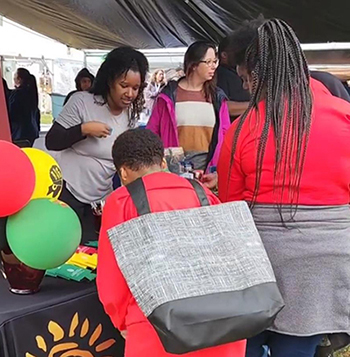 | Bria Brooks (Florida Public Archaeology Network) helped the project make significant connections to the Apalachicola community during her time as a project team member and graduate student at the University of West Florida. Here, she is representing the project during Apalachicola's Black History Month celebration. Photograph courtesy of Nicole Grinnan. |
"The 'People of the Apalachicola System: Exploring Cultural Heritage as a Vector for Ecosystem Planning, Management, and Adaptation' project is a foundational community-centered, collaborative initiative. Toward examining the interlaced natural and cultural heritage of the Apalachicola National Estuarine Research Reserve (ANERR) along Florida's northern Gulf of Mexico coast, the project team has demonstrated remarkable efforts toward community partnership and outreach to help preserve the cultural and ecological heritage of the Apalachicola River and Bay system. The project not only emphasizes traditional archaeological research but has also integrated community engagement at every phase, making it a model for unified heritage preservation efforts. . . . With over 12,000 years of documented human history, the Apalachicola system has an incredibly rich archaeological and historical record, including precontact heritage sites, sites of early 19th-century Black and Indigenous resistance, colonial and early American fortification, and boom-and-bust industrial sites from the turn of the 20th century." This award recognizes the excellent leadership of the project participants: Nicole Grinnan (PI, U. West Florida), Mike Thomin (FPAN), Bria Brooks (FPAN), Anita Grove (ANERR), Megan Lamb (ANERR), Tom Dawson (U. St Andrews), Lindsay Cochran (East Tennessee State U.), Kassie Kemp (FPAN), and Meredith Marten (UWF).
The Gender and Minority Affairs Committee of the SHA awarded the January 2026 Diversity Field School Award to the "Alaska Highway Project Archaeology Field School" hosted by MoHagani Magnetek and Justin Cramb of the University of Alaska at Fairbanks.
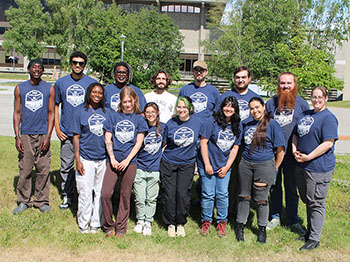 | Fieldschool participants. Photograph courtesy of MoHagani Magnetek. |
"The University of Alaska Fairbanks Anthropology Department, along with the Alaska Department of Transportation and Public Facilities, runs the Alaska Highway Archaeology Project Field School, which showcases a remarkable level of diversity. This diversity is evident in its location, subject matter, lead archaeologist, and student demographics, all of which reflect a rich intersectionality of ethnicity, gender, sexuality, military background, geography, and culture. The project is situated in historic district 49-TNX-00252, near the Robertson River Bridge and Tanacross, Alaska—on the ancestral lands of the Athabaskan and Dene People of the Lower Tanana. . . . PhD student and research assistant MoHagani Magnetek, an African American transgender woman and military veteran, under the guidance of Dr. Justin Cramb (UAF Anthropology), leads an enthusiastic group of students, many of whom identify as LGBTQ+ and BIPOC participate in a six-week historical archaeological field school focused on the World War II 1942-1943 winter cantonment of Company B, 97th Regiment, a segregated African American U.S. Army Corps of Engineers unit that faced the challenges of an Alaskan winter while confronting structural racism during the construction of a highway on indigenous lands."

Finally, the 2026 J. C. Harrington Award for Excellence in Historical Archaeology was awarded to Dr. Douglas V. Armstrong. Doug's commitment to the discipline was formative and transformational to the historical archaeology of the Caribbean, as evidenced by his work on Jamaica and the U.S. Virgin Islands, as well as the archaeology of the African Diaspora in New York and elsewhere. He has promoted a community-engaged archaeology that has generated collaborations with multiple local agencies and organizations, including the AME Zion Church and the U.S. National Park Service with his study of the Harriett Tubman Home for the Aged in Auburn, New York. A prolific author, Doug Armstrong has written 3 books, co-edited 2 volumes, and published over 100 articles. As a faculty member at Syracuse University, he shepherded 15 students through the completion of their doctorates and helped to establish one of the academic centers for African Diaspora archaeology. He has also given his time as a volunteer to SHA, organizing the 1992 annual meeting in Jamaica and serving on multiple committees, on the board, and as president (2001–2002), as well as serving a number of other associations." (SHA Spring 2026 Newsletter)
[Return to table of contents]
Open Access Articles from the
Journal of African Diaspora Archaeology and Heritage
The Journal of African Diaspora Archaeology and Heritage (Taylor & Francis Press) includes open access articles. You can find these on the journal website (link). Examples of articles currently available with free access include:
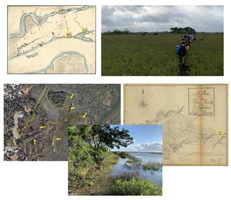
"Waiting on the Tide: Climate Change, Cultural Heritage, and Legacies of Anti-Blackness at Fort Mose," by Mary Elizabeth "Liz" Ibarrola. Abstract: Colonial Florida was a legal and jurisdictional borderland, within which many Afro-diasporic peoples negotiated to best protect their freedoms. However, they also found that emergent ideas about race were shaping the negotiation, circumscribing their options, and working to define a marginalized position for them within Florida society. The site of Fort Mose exemplifies this history and the challenges confronted by Afro-diasporic people within it. Furthermore, the threats to heritage preservation currently faced at the site highlight the ways which anti-Black ideology and action have had a persistent effect on the site, from its inception through the present day. Fort Mose was vulnerable by design. While it is today recognized for its symbolic role in the colonial era, as a site of Black heritage it is threatened not only by rising sea levels and increased storm activity, but also a historical legacy of marginalization. Keywords: Florida, climate change, environmental racism, African diaspora, cultural heritage (article link).
"We Remember Through the Spirit: Yoruba Intangible Heritage, Diasporic Belonging, and the Cultural Work of Aladura Churches in the UK," by Anna Catalani. Abstract: This paper explores how Aladura Churches sustain, adapt, and mobilize Yoruba intangible heritage – understood as oral traditions, rituals, music, and dance – to foster cultural identity and decolonial belonging in diasporic settings. Emerging in twentieth-century Nigeria and now established in the UK, Aladura Churches use heritage practices both as faith expressions and as tools for identity-building, continuity, and resilience. The article has two aims: first, to examine how these traditions are reinterpreted transnationally, reshaped to meet the spiritual and social needs of diasporic communities; and second, to assess how Aladura Churches' digital platforms function as spaces of cultural resistance, challenging marginalization and asserting diasporic identities. The paper argues that by integrating Yoruba heritage into sacred and civic life, Aladura Churches engage with global discourses on decolonization, multicultural citizenship, and heritage preservation. By doing so, they offer a decolonial model of heritage that reclaims memory, redefines legitimacy, and broadens cultural recognition in contemporary Britain. Keywords: Yoruba intangible heritage, Aladura churches, diasporic cultural resilience, decolonial heritage discourse, UNESCO intangible heritage convention, diaspora studies, religious practices, community heritage preservation (article link).
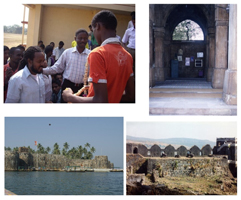
"Introducing African Mobilities and Heritage in the Indian Ocean World," by Shihan de Silva Jayasuriya. Abstract: As the United Nations International Decade for People of African Descent was approaching its end (2015–2024), the contributing authors were invited to write articles in order to complement its pillars: Recognition, Justice and Development. Whilst the articles were in progress, the UN adopted a second decade recognizing work that needed to be completed in order to address the full human rights of people of African descent. Recognition of People of African descent in the Indian Ocean World emanating from involuntary migration is a crucial part of bringing about justice. Building our episteme of African migrations continues as we enter the Second International Decade for People of African Descent (2025–2034). Keywords: African Heritage, Indian Ocean region, slavery, marronage, Sri Lanka, military, labour, abolition (article link).
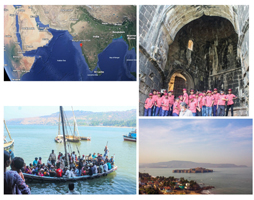
"Island Fort Janjira: Living Memories and Heritage," by Beheroze Shroff and Sonal Mehta. Abstract: An independent princely state (1621-1948), Janjira Fort and extended territories on the West Coast of India were governed by African Muslim rulers called Nawabs. This paper explores Janjira as a centre of trade and heritage tourism. We discuss protecting the Fort's cultural heritage and legacy of cosmopolitan communities who lived and worked in Janjira for generations. Our research is based on oral narratives and vivid memories of Indians of diverse backgrounds who served the Nawabs. History lives in their reflections of Janjira, as a unique place of the cultural formation of a microworld, arising from global processes of trade and commerce which defined its diverse racial and ethnic composition. We also offer the perspectives of descendants of the last Nawab of Janjira State. We conclude that Janjira Fort and the tombs of the Nawabs are heritage structures, an integral part of African History in India and need urgent attention for their preservation. Keywords: Sidis, Janjira Fort, living memories, heritage and tourism, cosmopolitanism, Indian Ocean (article link).
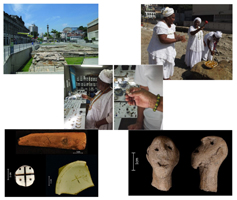
"Valongo, the Place of the Ancestors: Spiritual Practices among Enslaved Africans in Nineteenth-century Rio de Janeiro," by Tania Andrade Lima. Abstract: In 2017, UNESCO added Valongo Wharf to its list of World Heritage Sites. Located in Rio de Janeiro's Port Zone, the wharf is a place of memory associated with the transatlantic slave trade, which has been compared to other sites that have witnessed intense human suffering, such as Auschwitz, Hiroshima and Gorée Island, among others. This chapter explores the spiritual practices of the "wretched of the Earth," as Frantz Fanon named those Africans dehumanized by European colonialism. More specifically, it focuses on the Africans shipped to Valongo to be sold as slaves in Rio de Janeiro and who left vestiges of their spiritual beliefs, recovered through archaeological research. Here, these remains are analyzed from a decolonial perspective, born from the reflections of critical Latin American thinkers who reject the diverse forms of domination and oppression inflicted by Northern hemisphere powers on subaltern populations of the global South. Keywords: Valongo Wharf, urban slavery, spiritual beliefs, decolonial thought, diasporic communities, historical archaeology, archaeology of the African diaspora, descendant communities (article link).
[Return to table of contents]
Call for Proposals:
Restorative Justice in Heritage Studies & Archaeology
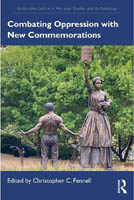
The Restorative Justice in Heritage Studies and Archaeology book series, published by Routledge Press and edited by Richard Paul Benjamin (University of Liverpool), Christopher C. Fennell (University of Illinois), and Nedra K. Lee (University of Massachusetts), seeks proposals for single-author, multi-author, or edited books. Restorative justice in heritage and archaeology embraces initiatives for reconciliation of past societal transgressions using processes that are multivocal, dialogic, historically informed, community based, negotiated, and transformative. This series will present works that promote the active and often unconventional ways that archaeologists, historians, and heritage scholars are contributing to a process of remaking. Our authors work to define and illuminate the best practices for restorative justice in these fields and to identify how practitioners and their collaborators are working to redress, reconcile, and remake contemporary society.
Such restorative justice efforts typically focus on multiple perspectives and modes of reconciliation, rather than a narrow vision of retribution and punishment. Reparation initiatives are often multivocal, layered, multiplex, and visionary in this way. Restorative justice initiatives often occur through such a collaborative process which entails relationship building and story-telling, accountability and truth-telling, and reparative engagement.
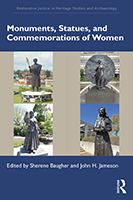
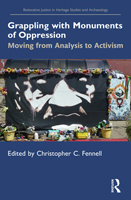
Our first volumes in the series are Grappling with Monuments of Oppression: Moving from Analysis to Activism (link), Combating Oppression with New Commemorations (link), and Monuments, Statues, and Commemorations of Women (link). Other volumes under contract and preparation address "archaeologies with heart" and justice and critical heritage issues in South Asia.
Interested in proposing a book for this series? Contact one of us: Nedra.Lee@umb.edu, Richard.Benjamin@liverpool.ac.uk, or cfennell@illinois.edu.
General guidelines for authors are available from Routledge Press.
Follow this initiative through our website, and on Facebook.
[Return to table of contents]
New Book
Understanding the African Diaspora
By Henry M. Codjoe
Routledge
438 pp., ISBN: 978-1032613970, 2025.
Description from the Publisher:
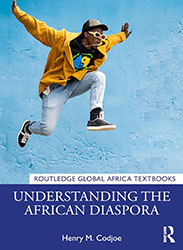 Understanding the African Diaspora offers a clear and engaging introduction to the global movements, histories, and cultural experiences of African and African-descended peoples, from ancient times to the present.
The book traces the wide-reaching impact of the African diaspora, shaped by both forced and voluntary migrations, including the transatlantic slave trade, colonialism, and more recent waves of movement. It explores how African-descended communities have contributed to and reshaped societies across the Americas, Europe, the Middle East, and Asia, while maintaining enduring ties to the African continent. Each chapter presents key historical developments, cultural expressions, and political struggles, supported by maps, timelines, and infographics that help bring complex topics into focus. Students are introduced to major debates in the field and regional case studies that highlight the diversity and resilience of African diasporic life.
Designed especially for courses in African Diaspora Studies, this textbook is also well-suited for African and African American history and related programmes. Its accessible structure and interdisciplinary approach make it ideal for undergraduate students, educators, and general readers seeking a strong foundation in one of the most significant and far-reaching movements in global history.
[Return to table of contents]
New Book
Afterlives of the Plantation:
Plotting Agrarian Futures in the Global Black South
By Jarvis C. McInnis
Columbia University Press
480 pp., ISBN: 978-0231215756, 2025.
Description from the Publisher:
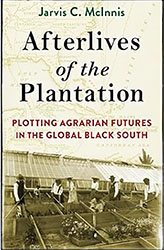 Built on the grounds of a former cotton plantation, the Tuskegee Institute, founded by Booker T. Washington, offered agricultural and industrial education as a strategy for Black self-determination. There -- and in many other communities in the U.S. South, the Caribbean, and Central America -- Black people repurposed and regenerated what had been a place of enslavement into a site for imagining alternative futures.
Jarvis C. McInnis charts a new account of Black modernity by centering Tuskegee's vision of agrarian worldmaking. He traces the diasporic ties and networks of exchange that linked Black communities in the late nineteenth and early twentieth centuries. Although Washington is often regarded as an accommodationist, McInnis shows how artists, intellectuals, and political leaders-including George Washington Carver, Jean Price-Mars, Zora Neale Hurston, Claude McKay, and Marcus Garvey-adapted Tuskegee's methods into dynamic strategies for liberation in places like Cuba, Puerto Rico, Haiti, and Jamaica. Even as the legacy of the plantation continued to circumscribe Black life, these thinkers found resources in its ruins to forge new theories and practices of progress, aesthetic innovation, and freedom that contributed to the New Negro Movement of the 1920s and 1930s.
In contrast to traditional understandings of Black modernity as urban and premised on northward migration, McInnis foregrounds rural settings and practices of place making, rootedness, and liberatory agriculture. Shedding new light on the transnational influence of a historically Black institution in the U.S. South, Afterlives of the Plantation remaps Black cultural, intellectual, and political histories down to the very soil.
[Return to table of contents]
New Book
Imagining the Past, Remembering the Future:
Forms of Knowledge in the Afro-Brazilian Diaspora
By Isis Barra Costa
Columbia University Press
440 pp., ISBN: 978-0231212632, 2026.
Description from the Publisher:
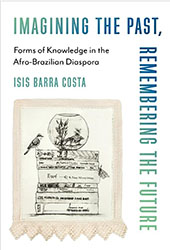 Over the centuries, from the transatlantic slave trade to voluntary mass migrations through the digital era, African cultural practices have taken root and transformed in the Americas. Even though Afro-Brazilians make up a large share of the global Black diaspora, and Brazilian culture in turn has been deeply shaped by African influences, their particular contributions remain overlooked.
Imagining the Past, Remembering the Future investigates the interlinked art, history, religion, philosophy, and cosmology of oral traditions across the Afro-Brazilian diaspora, arguing that these varied cultural expressions together constitute distinctive forms of knowledge. Through case studies of sacred and secular performances, Isis Barra Costa shows how Afro-Brazilian concepts and practices preserve and renew an ever-changing diasporic philosophy. Ranging across parades of Black royal courts, Carnaval performing groups, oracular literature, 'spirit-dictated' novels, and many other forms, she illuminates the survival and transformation of African cosmologies, epistemologies, and poetics in the Americas. Foregrounding oral narratives, Barra Costa sheds light on the nonhegemonic protagonists and canons of the Black Atlantic: the spaces and beings, kingdoms and heroes, philosophers and historians that orient Afro-Brazilian memory and imagination. By tracing forms of knowledge across the global African diaspora, this deeply interdisciplinary book reveals the transformative potential of Afro-Brazilian philosophical paradigms.
[Return to table of contents]
New Book
New Perspectives in Africana Studies:
Innovations in Africana Studies in the Era of Black Lives Matter
Edited by Crystal L. Edwards and Abul Pitre
Hamilton Books
352 pp., ISBN: 978-0761874089, 2026.
Description from the Publisher:
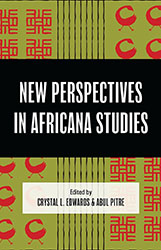 A timely and compelling collection of twenty essays exploring the evolving landscape of Africana Studies in the twenty-first century.
Rooted in the radical legacy of the nation's first Black Studies department, established in 1968 at San Francisco State University, this collection of essays brings together leading voices to engage with the most urgent issues facing people of African descent today.
Drawing from the foundational mission of Africana Studies as a liberatory and community-centered discipline, contributors critically examine how Africana Studies continues to grow as a body of knowledge, theory, and methodology rooted in an African-centered worldview. With sections such as An Afrocentric Approach to Education, Africana Studies in the Digital World, Gendering and Queering Africana Studies, Africana Family Studies, Africana Health and Wellness, and Africana Social Science Research, the book offers a wide-ranging but cohesive exploration of new perspectives, current debates, and future directions in the discipline.
Twenty unique essays address the essential questions: What are the contemporary approaches and innovations shaping Africana Studies? How do Africana Studies scholars address modern challenges while staying grounded in the discipline's original commitment to racial justice, community empowerment, and social transformation?
[Return to table of contents]
Book Review
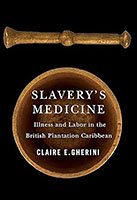
Claire Gherini. Slavery's Medicine: Illness and Labor in the British Plantation Caribbean. University of Virginia Press, 2025. 261 pp. (paperback), ISBN 978-0-8139-5275-8.
H-Net Book Review, published by H-Early-America, https://networks.h-net.org/h-early-america (February, 2026).
Reviewed for H-Early-America by Linsey McMillan (Independent Scholar).
Slavery's Medicine: Illness and Labor in the British Plantation Caribbean by Claire Gherini is a compelling and elegantly written exploration of plantation healthcare practices that places enslaved people and developments in the work of medicine at its core. Gherini draws on a wide range of well-known source material about British Caribbean slavery, ranging from medical journals, plantation management manuals, and scientific correspondence to personal diaries, and in doing so reconstructs the everyday workings of healthcare on slave plantations. Her analysis of these sources reveals plantation medicine in the late eighteenth century to early nineteenth century not as a benevolent response to slavery's innate violence and brutality, but as a key component of the labor regime itself. In Gherini's estimation, developments in plantation medicine from as early as the mid-1700s resulted in a system that was heavily rationalized, economized, and industrialized to maintain productivity regardless of human cost.
One of the book's main strengths lies in its examination of plantation medicine through the experiences and interactions of "varieties of people involved in healing" (p. 17). Gherini explores medical care and work through the perspectives of enslaved patients; enslaved healers and sick nurses; overseers and managers; absentee proprietors; and white doctors and their assistants. This approach allows her to demonstrate both the coercive power of plantation medicine and its fundamental shortcomings. Paradoxically, scientific developments in a burgeoning pharmaceutical industry and formalized changes to plantation healthcare such as the construction of hospitals and the introduction of professionally trained medics, hurt rather than healed enslaved patients. Indeed, the expansion of medical infrastructure and personnel on slave plantations in the late eighteenth and earl -nineteenth centuries created "working conditions [that] encouraged practitioners to mimic the managers' indifference to [enslaved patients]," and which "rendered most practitioners deaf to enslaved sufferer's voices" (p. 62). Predicated on systematization, discipline, and control, plantation medicinal practices subordinated the care of the enslaved to the proprietor's economic imperatives.
Throughout the book, Gherini challenges the idea of linear medical "improvement" in the era of British abolitionism, arguing that even as medical knowledge expanded and practices became more regulated, old power dynamics and systems of oppression persisted. Many proprietors focused on quick and inexpensive methods of treatment, favoring "one size fits all" remedies conjured in metropolitan laboratories over the medical and botanical know-how of enslaved healers. Further, they placed their faith in the healing abilities of "raw inexperienced youths" and "young and transient practitioners" to concoct and distribute medicines that were just as likely to kill as to cure (p. 63). Indeed, cure and prevention were secondary concerns for proprietors whose main concern was the maintenance of a viable workforce.
Chapter 1 examines the importance of enslaved orality as well as the impact of plantation hospitals, tracing their design, function, and changing purpose over time. Gherini shows that these buildings were not primarily spaces of care, but sites designed to facilitate managerial authority over the sick. By separating enslaved people from family and community networks, plantation hospitals enabled strict control over diet, medicine, and daily routine. They also offered proprietors moral leverage in the face of abolitionist critique, allowing them to gesture toward humanitarian concern. Yet Gherini complicates any reading of hospitals as purely coercive spaces. Enslaved people actively bid for admission, learning to deploy the "language" of illness; Gherini explains that "cacophony shaped sufferers' [medical] encounters, [as] did silence" (p. 28). As plantation medicine became increasingly regulated -- characterized by routine, enumeration, depersonalization of care, and a shift from older holistic approaches to metropolitan clinical practices -- enslaved people continued to find ways to come together, share knowledge, and endure. While managers could exert control over treatment, they could not fully discipline enslaved peoples' orality or collective survival strategies.
Chapter 2 shifts focus to the organization of medical labor and the emergence of what Gherini terms "circuit surgeons." She evaluates the impact of this system, whereby young and often inexperienced medical men traversed great distances to attend multiple estates, providing care to hundreds of enslaved people. This change marked a decisive evolution from bedside, patient-centered care toward systematized and homogenized clinical practice. Although such trends were not unique to plantation healthcare, Gherini demonstrates that the Caribbean slave plantation system took this change to an extreme not seen in other medical settings. Circuit medicine "casualized the trade of those who professed physic," driven by proprietors who prioritized efficiency and cost reduction at the expense of attentiveness and expertise, producing consistently poor standards of care (p. 101).
Central to this new system were seemingly innocuous plantation hospital or "hot-house" books. These simple record-keeping devices -- devoid of personalized observation or narrative -- became the primary tools through which doctors encountered enslaved patients. While essential to plantation management, they reduced illness to lists, symptoms, and outcomes, further depersonalizing care. For doctors operating within circuit systems, these books were often all they had to rely on, reinforcing the abstraction of enslaved bodies and deepening the distance between medical practitioner and patient.
Chapter 3 turns to the improvement or amelioration movement and the role of enslaved sicknurses. Gherini shows that while healers and sick nurses inhabited ostensibly more powerful positions on slave plantations, ameliorative practices constrained their ability to heal. Systematized changes to pharmaceutical dispensing, patient care, and an increasing reliance on overseers as medical providers all limited healers' autonomy and medical authority. Enslaved healers emerge here as deeply "haptic" figures, whose responsibilities extended far beyond the narrow definitions recognized by managers and proprietors (p. 124). Their work involved "everything from myriad acts of carework to different forms of manhandling, restraining, and guarding" and "also entailed observing and listening" (pp. 124-125). Gherini positions these healers as go-betweens, mediating between enslavers and the enslaved sick while managing the conflicting expectations of both.
Chapter 4 explores the precarious nature of knowledge making among plantation doctors. Examining case histories of enslaved patients written by plantation medics, Gherini demonstrates that plantation doctors did produce knowledge "but not in the volume or scope that might be anticipated from medical men whose work abetted the manpower needs of racialized labor regimes" (p. 180). Their work was shaped by conflict and cooperation with enslaved patients and enslaved healers, as well as by personal, professional, and environmental challenges on estates. Importantly, Gherini shows that enslaved people "often foiled practitioners' efforts to exploit them as a captive population to produce knowledge" and that they came to understand plantation medicine in much the same way they understood plantation labor: as a system riddled with opportunities for negotiation, rest, and survival (p. 155).
While Gherini offers a convincing reappraisal of sources that reduce enslaved people to enumerated, dehumanized factors, one wonders if deeper engagement with sources such as the Reports of the Protectors of Slaves might have added further rigor to some of the book's key arguments. These reports, which contain near-verbatim testimony from enslaved complainants who labored in the Crown Colonies of British Guiana and Trinidad, among other key British Caribbean territories, foreground enslaved voices far more directly than most sources utilized in this study. Though Slavery's Medicine examines a handful of these judicial complaints, more in-depth use of them might strengthen claims about enslaved responses to medical change, and in particular enslaved peoples' use of orality as a tool for survival.
Nevertheless, Slavery's Medicine is an ambitious and sophisticated work that engages productively with themes from economic, medical, political, and legal history, and effectively incorporates methodologies such as Saidiya Hartman's strategy of "critical fabulation" to reconstruct silences within the archive.[1] The result is a persuasive analysis punctuated by moments of impressive storytelling. Gherini's work offers a new way of understanding plantation healthcare as a complex system shaped by industrialization, imperial politics, and scientific change in the metropole. Moving beyond historiographies of disease, demography, and mortality that characterized the study of British transatlantic slavery and medicine from the 1960s, Gherini manages to center the experiences of enslaved patients even while analyzing abstracted data or dehumanizing literature produced by white medical men.[2] In doing so, she delivers an important and persuasive rethinking of slavery, medicine, and the economy of care in the British Caribbean.
Notes
[1]. Saidiya Hartman, "Venus in Two Acts," Small Axe, 26, no. 12 (2008): 1-14.
[2]. Examples of such important historiographical works include, Kenneth Kiple, The Caribbean Slave: A Biological History (Cambridge University Press, 1984); David Eltis, "Mortality and Voyage Length in the Middle Passage: New Evidence from the Nineteenth Century," Journal of Economic History 44, no. 2 (1984): 301-8; Philip Curtin, The Atlantic Slavery Trade: A Census (University of Wisconsin Press, 1969); and Barry Higman, Slave Populations of the British Caribbean, 1807-1834 (University of the West Indies, 1995).
[Citation: Linsey McMillan. Review of Gherini, Claire, Slavery's Medicine: Illness and Labor in the British Plantation Caribbean. H-Early-America, H-Net Reviews. February, 2026. This work is licensed under a Creative Commons Attribution-Noncommercial-No Derivative Works 3.0 United States License. H-Net permits the redistribution and reprinting of this work for nonprofit, educational purposes.]
[Return to table of contents]
Book Review
Roquinaldo Ferreira. Worlds of Unfreedom: West Central Africa in the Era of Global Abolition. Princeton University Press, 2025. vii + 290 pp. (cloth), ISBN 978-0-691-17758-8.
H-Net Book Review, published by H-Africa, https://networks.h-net.org/h-africa (February, 2026).
Reviewed for H-Africa by John K. Thornton (Boston University).
Roquinaldo Ferreira takes on a broad subject in this work: the impact of abolition in West Central Africa, a large region, in much of the second half of the nineteenth century. Thanks to Portugal holding out for a long time against abolition, the impact was not felt until around the middle of the century, but before that, some of the highest levels of exporting humans were achieved in West Central Africa's long history with the slave trade.
One cannot but be impressed with the level of scholarship that Ferreira deploys in this book. Hundreds of archival sources join the travelers' accounts that usually underlie studies of African history. The Angola archives are especially important, and as more and more scholars visit them, we can expect much more local flavor than one finds in other archives in Africa, thanks to the substantial local footprint that Portugal had in the region.
Ferreira takes a sort of pointillist approach to the subject; rather than attempting a wide-ranging review of the material, he takes individual case studies that illustrate aspects of the topic. These events typically involve small groups of people, whose lives in this period have been well documented; he then uses these events as a route into larger themes. Ferreira has used this technique to good effect in earlier work (Cross Cultural Exchange in the Atlantic World: Angola and Brazil During the Era of the Slave Trade, 2012) as well.
He begins with the story of José Ferreira Gomes. He was born in Benguela but soon after birth crossed the Atlantic to Brazil, and then back and forth again. This narrative covers the complex relationships between Brazil, Angola, and Portugal as nationalism, abolition, and the complexities of Lusitanian colonialism twist through the period. The second chapter focuses on Luanda, the only significant city in Angola (Benguela being a poor second), and the life of Francisca Joaquina do Amaral, a woman with feet firmly in the multiculturalmix of Luanda, where African, European, and Luso-Angolan norms meet, mix, and interact.
Chapter 3 focuses on a recently enslaved man, Tabião, set to be sent off to Brazil but who manages to arrange for a rebellion, ultimately working through the contradictions of a slave trading society making a transition to free (or at least semifree) labor. The fourth chapter returns to transatlantic networks, now including the United States engaging in its last piece of the slave trade. Ferreira examines these networks through the life of Agusto Garrido, a truly Atlantic-based figure.
Chapter 5 plays on gender, commerce, and contacts with the Lunda Empire through the life of the wealthy and influential merchant and financier Ana Joaquina dos Santos Silva. It follows her rivalry with the diplomat Joaquim Rodrigues Graça in the court of the powerful Lunda emperor Naweej II. The sixth chapter also deals with the still independent powers, in this case Kongo, as French and Portuguese interests worked with the weak king Henrique II to divert the slave trade to other interests, ultimately copper mining.
Finally, in the last chapter, Ferreira moves to a more general topic on how the end of the Atlantic slave trade shifted forced and unfree labor to produce inland, perhaps an improvement for those caught up in the process of capture and sale. Copper mining, coffee growing, and trading in products like honey, wax, and ivory came to the forefront, but enslavement and transportation to support these endeavors did not cease.
The local stories that Ferreira uses are interesting, even fascinating, but at times the larger picture is lost. It is inevitable, but Ferreira does circle back to the larger themes enough to keep the reader engaged. Furthermore, one of the more surprising aspects of this work is that Ferreira never engages the southern trade from the Central Highlands, especially Viye, in the interior. His chapter on Lunda touches peripherally on it, but it is another large story. Ovimbundu caravans along with Cokwe raiders were in the process of undermining the vast Lunda Empire, and one would not know from the maneuvers in Naweej's court the implications of this. One might have chosen the travels and adventures of Lazlo Magyar, himself an Atlantic traveler in a multi-centered period dealing with multiple locations (having visited West Africa and the Congo River before settling in Viye), as a protagonist.
[Citation: John K. Thornton. Review of Ferreira, Roquinaldo, Worlds of Unfreedom: West Central Africa in the Era of Global Abolition. H-Africa, H-Net Reviews. February, 2026. This work is licensed under a Creative Commons Attribution-Noncommercial-No Derivative Works 3.0 United States License. H-Net permits the redistribution and reprinting of this work for nonprofit, educational purposes.]
[Return to table of contents]

©2026 African Diaspora Archaeology Network
Copyright and all rights reserved by
individual authors for each article.
Please send comments, suggestions,
or questions to the editor
Last updated: April 15, 2026
Text only menuSearch
|